Minesweeper
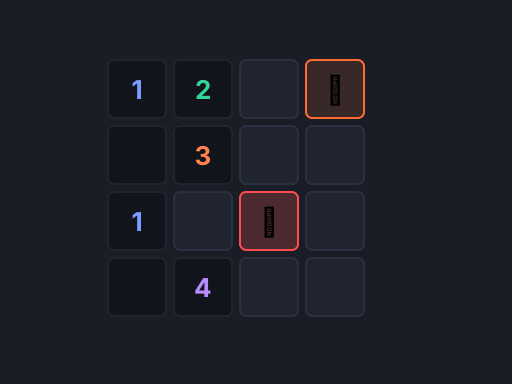
Clear the board without detonating a mine. The numbers tell you where they are.
Minesweeper · Puzzle
🎮You May Also Like
About Minesweeper
Minesweeper is a deduction game disguised as a grid of grey squares. Mines are hidden underneath; every safe square you uncover shows a number telling you how many of its eight neighbours are mined. From those numbers alone you can work out, square by square, where the mines must be and where they cannot be.
The version here offers three sizes: 9×9 with 10 mines, 12×12 with 22, and 16×16 with 45. Mine density climbs with size, so the large board is not just longer, it genuinely requires more careful reading. Your first click is always safe — mines are placed after you click, avoiding both that square and everything touching it, so you always open into a usable area rather than dying on move one.
How to Play Minesweeper
- Pick a board size and click any square to start. The timer begins on that first click.
- A number tells you how many mines touch that square. A blank square has none, so all eight neighbours open automatically — this is what produces the large cleared regions.
- Mark squares you are confident are mined with a flag. Flagged squares cannot be opened by accident, and the counter at the top shows how many mines you have left to find.
- When a numbered square already has that many flags around it, click the number itself to open all its remaining neighbours in one action. This is called chording and it is the main way to move quickly.
- Open every safe square to win. Clicking a mine ends the run and reveals the whole board.
Controls
Desktop: left click reveals a square. Right click places or removes a flag. Left clicking an already-open number chords it — opening its unflagged neighbours, but only when the flag count around it matches the number.
Mobile and tablet: tap to reveal. Because there is no right click, use the Flag mode button under the board to switch taps between revealing and flagging; the button highlights in orange while flag mode is on. Chording works the same way — tap an open number with flag mode off.
The mine counter at the top left shows mines minus flags placed, not mines actually found. If you flag a square wrongly the counter still goes down, which is a useful reminder that it is a tally of your assumptions, not the truth.
Tips and Tricks
- Work the edges of open regions, not the middle. Information only exists where opened numbers touch unopened squares.
- Learn the 1-2-1 pattern. Along a wall of three unopened squares showing 1, 2, 1 above them, the mines are under the two ends and the middle is always safe. It comes up constantly.
- Flag only what you have proven. A wrong flag poisons every deduction that depends on it, and you will not notice until the board stops making sense.
- Chord aggressively once flags are in. On the 16×16 board, clearing square by square is what costs you the time, not the thinking.
- When genuinely stuck, count the remaining mines. Late in a board the global count often resolves a corner that local numbers cannot.
Frequently Asked Questions
Can I lose on the very first click?
No. Mines are placed after your first click, and the generator avoids both that square and all eight squares around it, so your opening click always reveals a blank area.
How do I place a flag on a phone?
Use the Flag mode button below the board. With it on, taps place and remove flags instead of revealing squares. Turn it off to go back to revealing.
What is chording?
Clicking an already-open number that has exactly as many flags around it as its value. It opens all remaining neighbours at once. It is the fastest way to clear a board, but only as reliable as your flags.
How many mines are on each board?
9x9 has 10 mines, 12x12 has 22, and 16x16 has 45 — roughly 12%, 15% and 18% density respectively.
Is my best time saved?
Yes, separately for each board size, stored in your browser. It only updates when you clear the whole board.
Last updated 2026-09-08 · More Puzzle games